A likeness within reach
Frederick Douglass left an argument about who could possess a picture, and how pictures could change a society.
Frederick Douglass did not treat a photograph as a minor convenience. In a manuscript cataloged by the Library of Congress as an 1861 "Lecture on Pictures," he placed pictures beside other inventions that had altered the shape of modern life. A passage about celebrated inventors gives way to an inserted line about the father of modern pictures being overlooked. The page is visibly a working document: additions crowd the margins and sentences are crossed out. [1]
The changes matter. They bring us close to an argument being composed, rather than a slogan extracted from a finished monument. Douglass is considering what a new abundance of pictures does to a society. The question is not only whether a photograph resembles someone. It is also who can possess a likeness, how it circulates, and what habits of looking that circulation creates.
One of the clearest claims sits on the next leaf. In a discussion of the ordinary rule that demand regulates supply, he writes:
Supply regulated demand.
The three words are visible on manuscript image 3, numbered page 2. They describe his argument about pictures becoming abundant and accessible. They are not a universal promise that manufacturing more products creates paying customers. [1]
Douglass gives that abundance a social geography. Small towns have picture galleries; even a crossroads can acquire one. A farmer can have practical work done for a horse and obtain a picture of himself. Those observations, paraphrased from the same leaf, imagine photography entering the places and transactions of ordinary life. The gallery is no longer only a destination for a person with money to spare on a grand portrait.
In another passage, on manuscript image 2, the comparison becomes sharper. The likeness that had been a luxury of the wealthy is presented as something now available to a servant girl whose income is small. This is Douglass's assertion in a draft, not independent proof that every studio charged an affordable price or every person had equal access. The force of the passage lies in the comparison he chooses: representation as a possession that should no longer mark only status. [1]
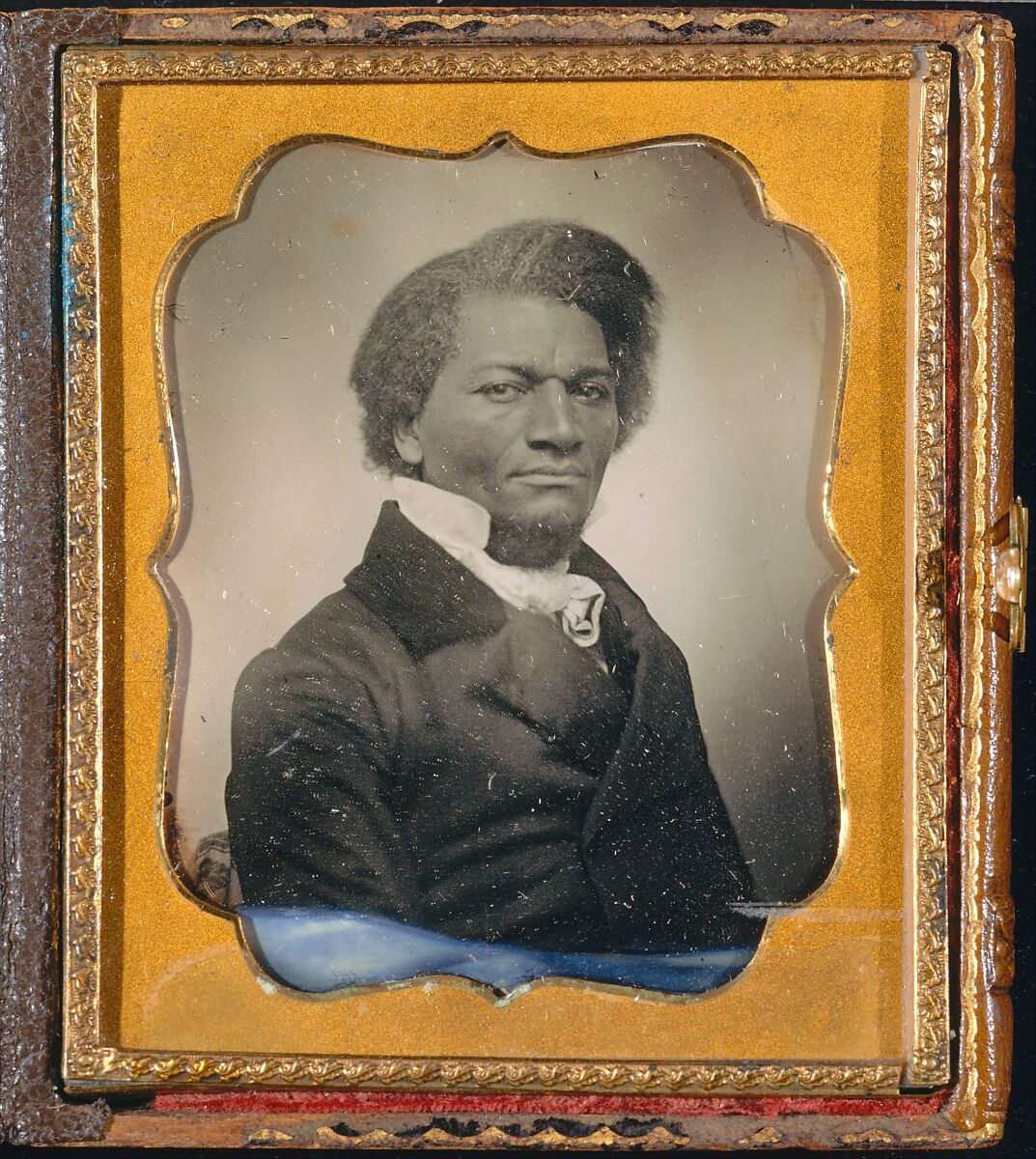
The portrait reproduced here gives the argument a face. The Metropolitan Museum of Art dates this daguerreotype to approximately 1855 and identifies the photographer as unknown. Its collection entry describes Douglass's use of photography to oppose distorted representations of African Americans and notes that he circulated portraits in several formats over decades. [2] The museum's account supplies historical interpretation; the object supplies one particular surviving likeness.
We should not make the photograph say more than it can. Its pose and clothing are visible. The circumstances of this sitting are not established by the object record. A reader cannot reconstruct the conversation with the photographer, the time required to hold the pose, or Douglass's private response to the finished plate. Nor is the image evidence that he had already formulated every argument of his later lecture.
Placed beside the manuscript, however, it changes the reader's encounter with both. The subject of the picture is also a writer thinking about pictures. He is not merely available for our inspection; he left arguments about the medium through which we inspect him. The archive lets us place a represented person and a person making claims about representation on the same spread.
Sojourner Truth's portrait card offers a useful comparison. Its printed sentence connects the sale of a likeness to the support of a living person. Douglass's manuscript connects the availability of likenesses to social life. The objects are different: one is a card intended to circulate, the other a working text. Neither needs to be reduced to an inspirational quotation to remain powerful.
A reader may notice something else in the manuscript: revision. The insertions, deletions, and shifts of emphasis interrupt any temptation to treat nineteenth-century speech as a single clean text waiting for us to copy. A handwritten lecture draft is evidence of composition. It does not tell us exactly which sentences an audience heard on a particular evening.
That is why the page belongs in the issue, not just the quotation. The original image makes the editorial's work inspectable. The reader can find the line, see what surrounds it, and understand the kind of source being used. The publication adds context and a route through the documents; it does not replace the documents with a confident voice of its own.
Douglass's question remains productive for an archive magazine. A portrait can endure as a recognizable face while the person's words become detached from it. Bringing them together restores something important: the photographed subject's capacity to think about how images work. The likeness becomes an entry into an argument, rather than the end of one.
Continue reading