One speech, two printed lives
An 1851 newspaper report and an 1863 recollection carry different versions of Sojourner Truth’s speech.
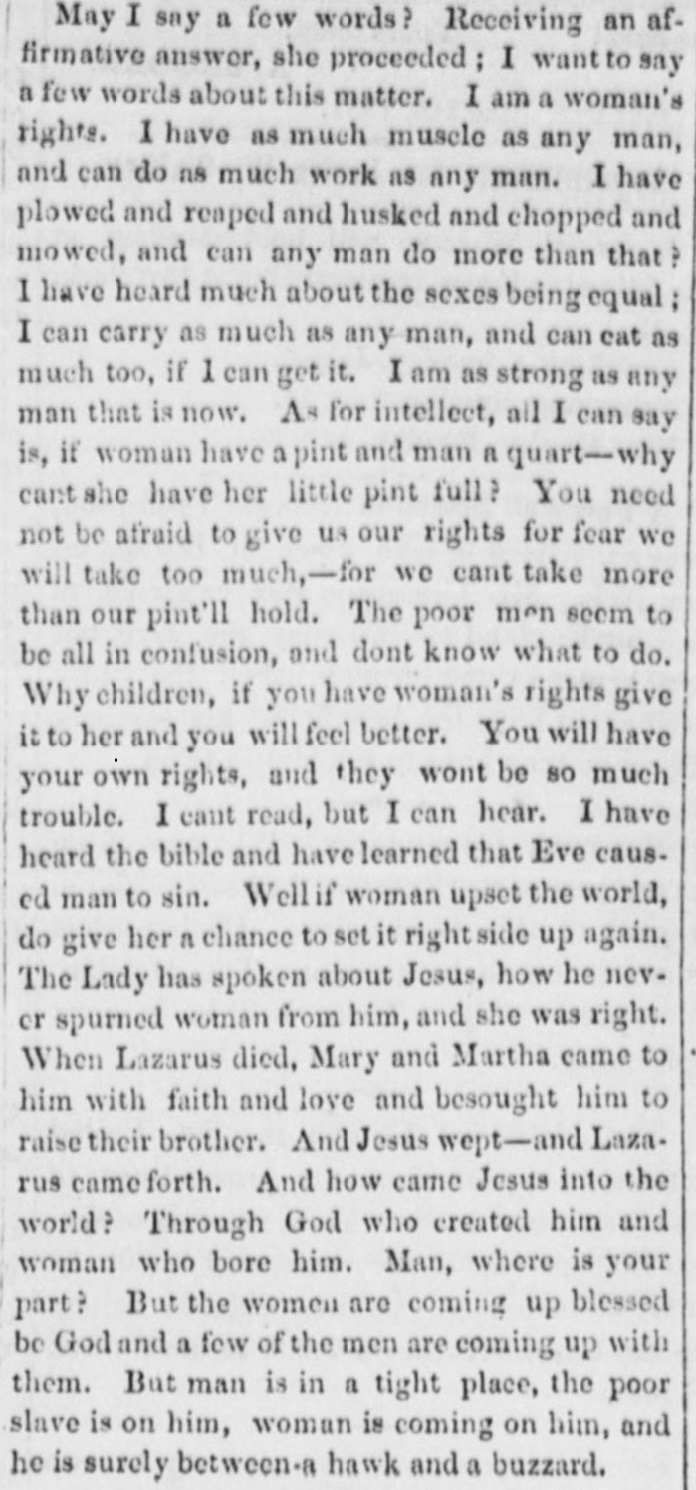
In the newspaper excerpt published in 1851, Sojourner Truth begins by asking permission to speak. An affirmative answer is reported. Then the account gives her a striking sentence:
I am a woman's rights.
The grammar may surprise a reader expecting a familiar slogan. That surprise is worth keeping. The words are visible in the reproduced passage from the Anti-Slavery Bugle of June 21, 1851, rather than being supplied by a modern editorial to make the speech sound more familiar. [1]
The passage moves through physical work, strength, food, intellect, and biblical examples. Near its close, women are described as coming forward; men occupy a difficult position between their demands and those of enslaved people. A reader can trace an argument in this account without finding the refrain that later became attached to the speech.
The excerpt is not the only part of the evidence. A reproduced introductory paragraph, also supplied by the Library of Congress, says the speech cannot be adequately transferred to paper. It points to Truth's gestures, presence, and voice as things the report cannot preserve. [2] The nineteenth-century account is making its own limitation explicit.
That admission complicates the word transcript. Printed quotation marks can look precise, but they do not prove that a reporter captured each spoken word exactly. The surviving newspaper is direct evidence of what the newspaper printed. It is also an intermediary between a person speaking and a person reading years later.
Twelve years after the Akron convention, Frances Dana Gage's account appeared in print. The Library of Congress identifies its publication in The Independent on April 23, 1863, and the National Anti-Slavery Standard on May 2, 1863. [3] We inspected the Library's reproduction of column 4 from the latter publication. Its language and its rendering of Truth's voice differ substantially from the 1851 passage. [4]
The two accounts do share an argument a reader can recognize. Both use a comparison between a small measure and a larger one to discuss intellect and rights. Both discuss Christianity and woman's place in its story. Shared themes, however, are not identical wording. An editor who takes the familiar phrase from one version and the tighter argument from another creates a third text.
The later account gives much more space to the reactions of the crowd. It describes gestures and intense emotion. Those descriptions are part of Gage's recollection as it reached print; they are not an invitation for this magazine to write an eyewitness scene in its own voice. We can compare the records without pretending to stand in the hall.
The difference also reaches beyond wording. The Library's historical analysis points out that Gage rendered Truth's voice in a Southern dialect, whereas Truth had been enslaved in New York and first spoke Dutch. [3] That is an important reason to identify the version whenever quoting. The accent a printed account appears to give a person can become part of the public's picture of her.
There is no need to discard a record because it is difficult. The 1851 report and the later recollection each belong to the history of how the speech circulated. Their disagreements are part of the story. The publication's responsibility is to keep the dates, writers, and kinds of evidence visible enough that the reader can understand what is being compared.
Truth's portrait card offers a different contact with her public image. Its name and slogan survive on the physical object. A printed speech report offers words mediated by a recorder. A later account adds another interval and another writer. Placing them together does not produce perfect access to Truth. It does show the routes through which her image and words reached others.
In an archive edition, an unresolved difference can be more illuminating than a polished certainty. The useful question is not simply which sentence is most memorable. It is who printed it, when, from what position, and how we know.
Continue reading