She sold the picture. She kept the name.
Sojourner Truth used a portrait card to connect her public image to the support of a living person.
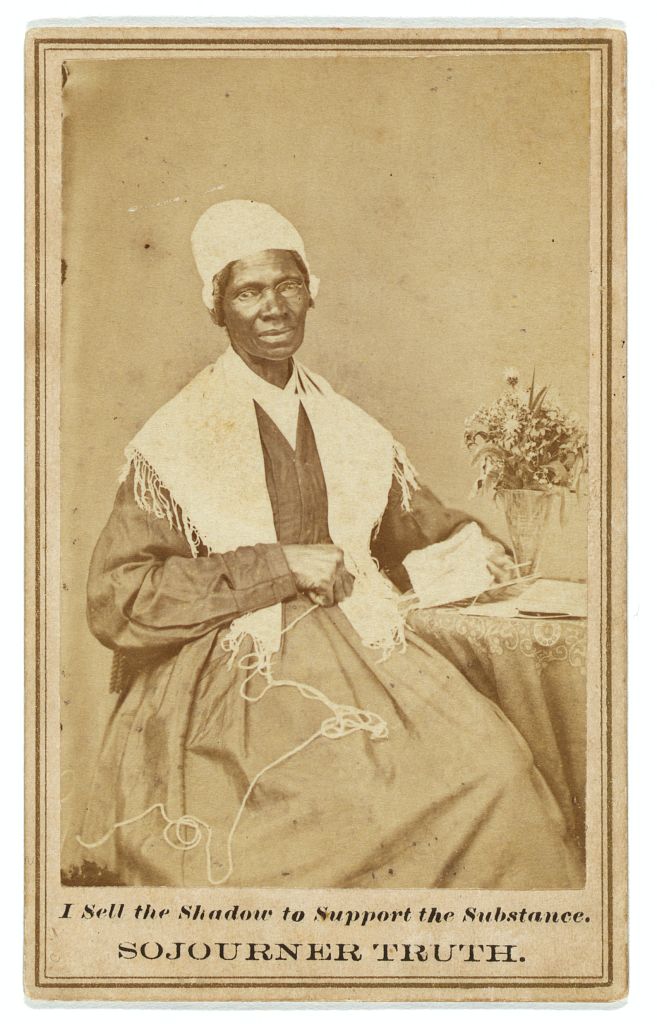
There is a photograph, and there is the sentence beneath it. Sojourner Truth sits beside a table, with knitting in her hands and a book nearby. Her name is printed across the bottom of the card. Immediately above it comes a declaration:
I Sell the Shadow to Support the Substance.
The words belong to the object. They are visible on the surviving card, not a line supplied by a novelist or an interviewer imagined after the fact. The Library of Congress dates this portrait to approximately 1864 and records the slogan beneath it. Its notes also record copyright in Truth's name that year. [1]
The sentence makes the photograph something more specific than a likeness. It identifies an exchange. A buyer can take away an image; the person pictured needs the income that sale provides. The distinction between shadow and substance is unusually economical: the reproduction travels, while a living body still has to be supported.
That reading has a practical basis. The Smithsonian's National Portrait Gallery describes Truth selling copies of her photograph and her narrative to support her antislavery campaigning. The institution places those sales within her public life, rather than treating the card as a private keepsake that accidentally became famous. [2] This was an image with work to do.
Look again at the full card. The frame, the pose, the text, and the name all reach us together. A crop that retains only the face may be visually striking, but it removes the terms under which the object introduced its subject. In this case, the margin is part of the story. It tells a reader that the woman has a name and that the picture is being offered for a stated purpose.
The book and the knitting invite interpretation, but they also set a limit. We can see objects arranged in the photograph. We cannot identify the book from this view, recover everything that happened in the studio, or know what Truth thought while sitting for it. The Smithsonian's discussion of her portraiture likewise notes uncertainty about the book. [3] A good caption should not turn a suggestive prop into a proven memory.
This distinction matters particularly when a person survives in several kinds of records. A portrait shows a pose. A printed caption supplies words attached to that portrait. A newspaper supplies a reporter's account. A later memoir supplies a memory, edited and published at another moment. The records can illuminate one another, but none should silently stand in for all the others.
Truth's best-known speech illustrates the difficulty. The Smithsonian's The Whole Truth examines the differences between the 1851 reporting associated with Marius Robinson and the later version associated with Frances Dana Gage. [3] Those versions need comparison, not a composite assembled into a supposedly exact speech. A quotation can be famous and still require a careful explanation of how it reached print.
The newspaper comparison now has a firm source to examine. We located and visually inspected the Library of Congress's reproduction of the passage from the June 21, 1851 Anti-Slavery Bugle, fourth newspaper page (continuous issue pagination 160). The reported speech includes "I am a woman's rights." That is a sentence in Robinson's printed account, not a claim that an audio recording proves her exact delivery. The later famous refrain does not appear in that reproduced speech passage. [5]
The portrait is already a different sort of evidence. Its slogan can be checked against the pictured object. It gives the feature an unusually firm point of contact: here are the printed words, here is the card that carries them, and here is the named person it represents. We do not need to invent a conversation to make that encounter consequential.
For a magazine working with archives, the task is to restore those connections. Put the name back beside the face. Keep the caption with the photograph when the caption changes its meaning. Find the speaker's words where they survive, and identify the intermediary when they reach us through someone else. If a record cannot be found, say what remains unknown.
Truth's card offers both an object to study and a reminder about the economics of a public image. The picture was reproducible. The substance was a person. An archive may preserve the first long after the second has died; an editorial should work to bring the two back into relation.
Continue reading